
AI Adoption for Nonprofits: From Sprawl to Impact
The evolution of AI has the potential to create a ton of value for nonprofits, as agents are growing from assistants, confidantes, or interns into a more active role in fundraising, grantwriting, and more. But this shift raises the real question of AI adoption for nonprofits: how do you move from scattered experimentation to something that actually works at scale? Alongside the excitement of realizing true value comes another problem organizations are now facing: AI sprawl.
What is AI sprawl?
Somewhere in your organization, a program director may be using a free AI tool to draft grant reports. A development associate has a personal subscription they use to write donor emails and summarize conversations. Your IT team approved a license for one department that two others quietly started sharing.Nobody planned this and nobody is governing it, yet your organization is already using AI. This is a pattern of informal adoption known as “AI sprawl.”
AI sprawl makes it difficult to get real, organization-wide value from AI tools. In fact, it comes with a lot of costs. When different departments independently adopt AI tools, there is no central governance plan or strategy. This often leads to redundant and fractured agents which introduces issues like security and compliance risks, siloed data, unnecessary spending, and more.
This is the reality in many mission-driven organizations right now. AI adoption isn't happening too slowly, but rather it's happening unevenly, informally, and without the infrastructure to turn scattered usage into strategic advantage.
The three tiers of AI value for Nonprofits
So how does an organization extract real value out of AI? Well, the more you invest in organization-wide learning and adoption at the early stages of AI use, the greater you can build on it in a healthy way, compounding its value steadily over time.
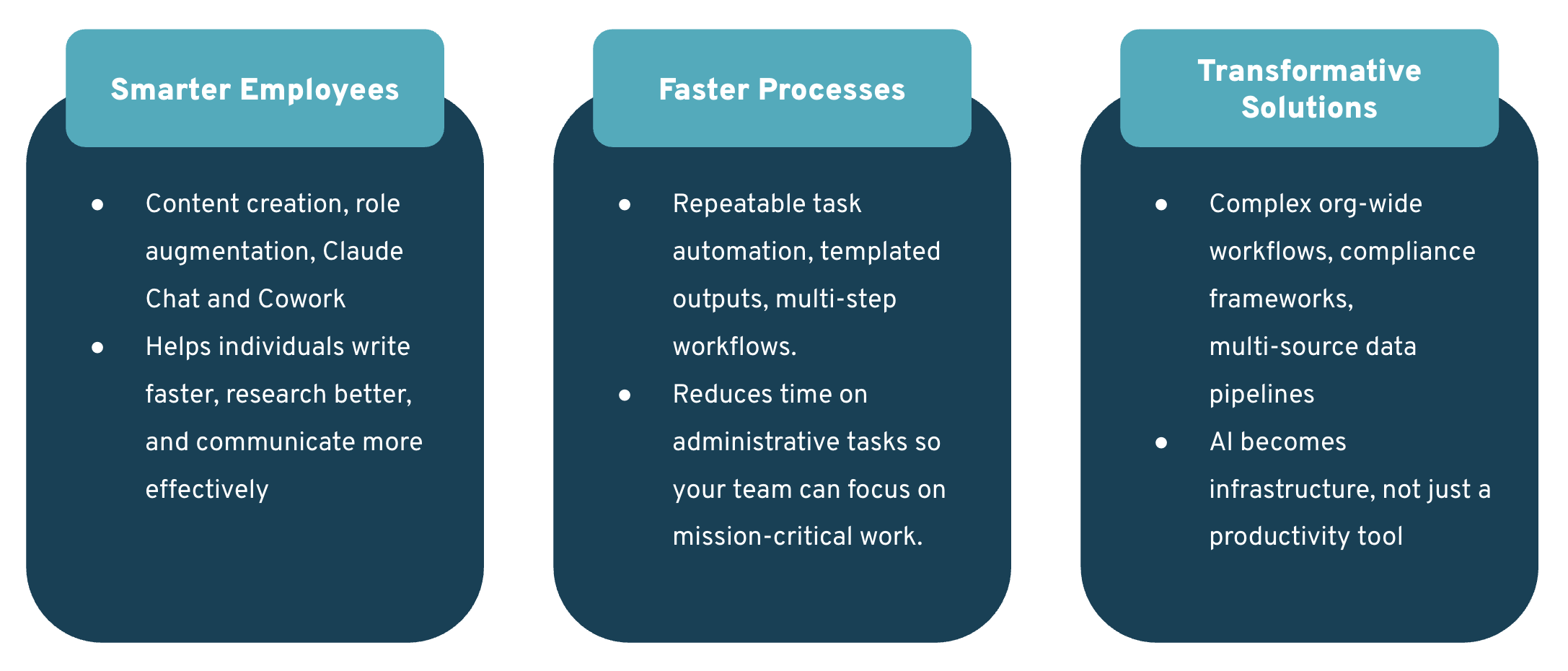
It's helpful to think about AI value in three tiers:
Tier 1: Smarter Employees. Staff use AI to move faster on individual tasks like drafting content, summarizing documents, answering questions, doing research. This is where most nonprofits live today, and it's genuinely useful, but the value is siloed. When an employee uses AI on their own, the organization doesn't learn because nothing gets systematized. The same work gets redone by a colleague tomorrow.
Tier 2: Faster Processes. AI gets embedded into workflows such as intake forms, case management, donor communications, program reporting. Now you're compounding the value. The efficiency isn't tied to one person's habits, but instead lives in the process itself.
Tier 3: Transformative Solutions. AI becomes infrastructure that allows your team to focus entirely on high-judgment, high humanity work. You’ve used it to create and run applications tailored to your needs. It connects previously-disparate systems, automates everyday decisions, and surfaces helpful insights. This tier is where mission impact at scale becomes possible.
Most nonprofits are stuck in tier 1. They are not stuck because they lack the technological ability, but because there's no structured path from individual usage to organizational capability.
Want to learn more about moving from experimentation to impact? Watch the webinar.
Why good intentions aren't enough
An organization decides to move forward with AI, they provide the tools, and staff are experimenting, but there still doesn’t seem to be much organization-wide momentum. Why is there a roadblock in getting past “Smarter Employees”?
A few reasons come up again and again:
No governance & no consistency. When each team member chooses their own tools and prompts, you get inconsistent outputs and unknown data exposure. What's being entered into these tools? What are the terms of service? Who owns the outputs? Without a policy framework, these questions don't get asked until something goes wrong.
No shared language for what's working. If one program officer found a workflow that saves her six hours a week, that knowledge rarely travels. There's no mechanism to capture, test, and scale what's effective.
Lack of proper onboarding. The organization turns on AI tools in existing applications like Google Workspace or Microsoft 365, or they may even invest in an AI tool like Claude. The roll out happens, but adoption stagnates without a proper onboarding. Some people use them but some don’t, and the licenses become a line item nobody can justify neither renewing nor stopping.
The "one big project" trap. AI is sometimes framed as a transformation initiative with a clear beginning and end. We find that AI implementation is iterative by nature. It requires experimentation, evaluation, and ongoing refinement. Treating it like a one-time project almost always works against long-term adoption.
Establishing AI governance for nonprofits is vital
A lot of organizations want to move fast and figure operating procedures out later, but from what we’ve seen establishing governance can’t wait.
Data privacy is not just a technicality, but a trust issue. Your beneficiaries, donors, and program participants likely didn't consent to having their information processed by third-party AI systems and your staff shouldn't have to guess whether a given tool is safe to use with client data.
A lightweight AI use policy — one that's clear, practical, and doesn't require a legal background to read — is one of the highest-leverage things a nonprofit can do early in their AI journey. It gives staff confidence to experiment within defined guardrails, it protects the organization, and it sets the foundation for Tier 2 and Tier 3 adoption. The goal is to have data flow through systems rather than staying in individual siloes.
The cost of staying in tier 1
Informal AI adoption isn't free. There are real costs: inconsistent outputs that carry risk, data exposure that may violate donor or beneficiary trust, and more.
More practically, the nonprofits that build structured AI capability now will be better positioned to serve their missions at scale. The ones that wait for a perfect moment will find themselves several iterations behind.
Thinking about ways to move beyond tier 1? Check out our AI Adoption Guide → Access Guide
Ready to move beyond ad-hoc AI adoption? Idealist Consulting works with nonprofits to build AI infrastructure that compounds over time. Book a call to talk about where your organization is and where it could be.